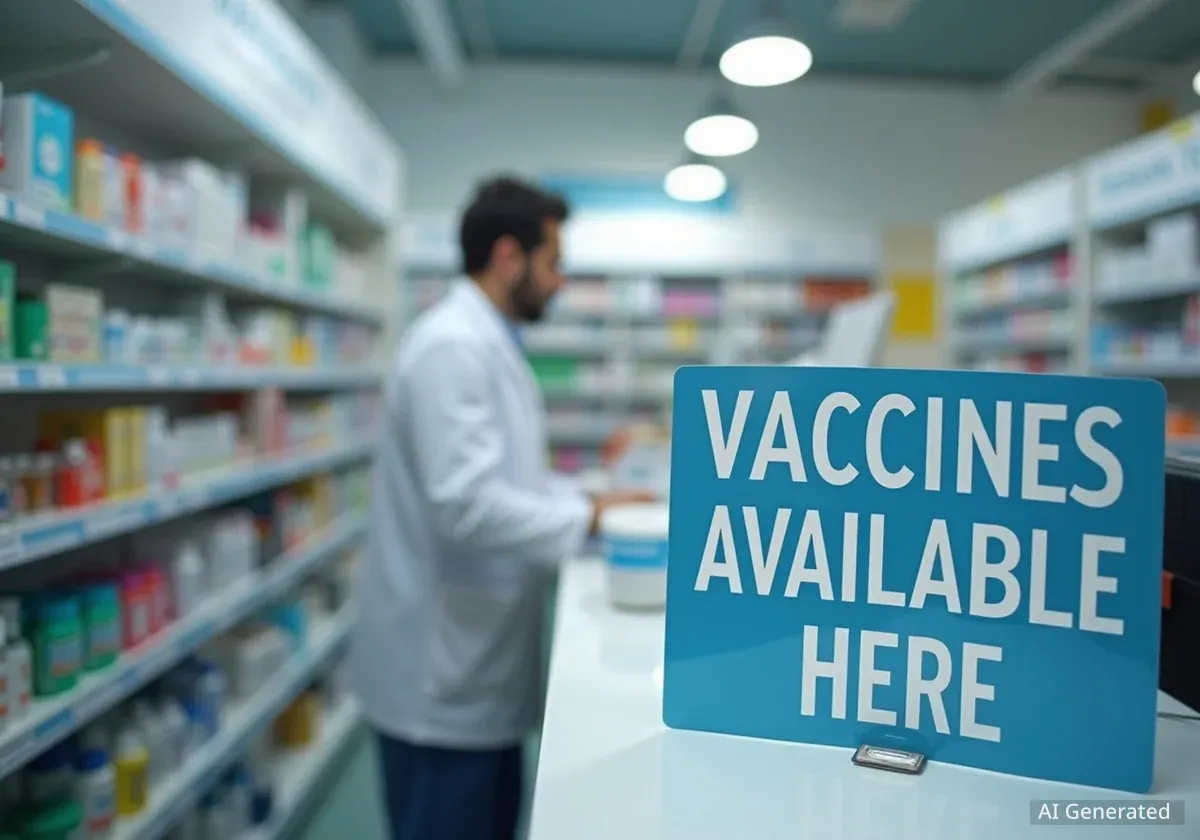

Updated COVID-19 vaccines are now available for the fall season at major drugstores across the United States. Despite a recent shift in guidance from a key government advisory panel, major insurers and federal health programs have confirmed that they will continue to cover the cost of the shots for most Americans.
This ensures that access to the vaccine remains broad, even as the official recommendation framework has changed. Pharmacies are prepared for administration, and eligibility criteria have been established for older adults and those with specific health risks.
Key Takeaways
- Major health insurers and federal programs will continue to cover the cost of updated COVID-19 vaccines.
- Eligibility for the new shot is focused on individuals aged 65 and older, and younger people with high-risk health conditions.
- National pharmacy chains like CVS and Walgreens have the updated vaccines in stock across all 50 states.
- Proof of a high-risk condition is not required at pharmacies; patient self-attestation will be accepted.
Navigating the New Vaccine Recommendations
A significant development this season involves the recommendation from vaccine advisers to the Centers for Disease Control and Prevention (CDC). On Friday, the committee chose not to issue a specific, broad recommendation for the shots.
Instead, the advisers stated that individuals could make their own decisions about vaccination. This is a departure from previous years when a universal recommendation was standard for most of the population.
Why CDC Recommendations Matter
Typically, formal recommendations from the CDC's advisory committee are a crucial trigger for insurance mandates. These recommendations ensure that vaccines are covered under laws like the Affordable Care Act and through federal programs. The recent decision to not issue a broad recommendation raised questions about whether insurance coverage would be affected.
However, federal officials have moved to reassure the public that coverage will not be interrupted. The recommendations from the advisory committee still require final approval from the CDC's director, a step that is almost always a formality.
Insurance Coverage for Fall COVID-19 Shots
Following the advisory committee's vote, the Department of Health and Human Services (HHS) released a statement to clarify the situation regarding payment for the vaccines. The department confirmed that the committee's decision still allows for full immunization coverage.
An HHS spokesperson specified that this coverage extends across multiple platforms, including:
- Medicaid
- The Children’s Health Insurance Program (CHIP)
- Commercial health plans sold on insurance marketplaces
- The federal Vaccines for Children (VFC) program
The Vaccines for Children Program
The VFC program is a critical component of public health, financing approximately half of all childhood vaccinations administered in the United States each year. This program typically covers any vaccine that receives a formal recommendation from the CDC committee.
Major private insurers have also affirmed their commitment to covering the shots. America’s Health Insurance Plans (AHIP), a trade group representing most major insurers, announced that its members will continue to provide the vaccine at no cost to patients through 2026.
UnitedHealthcare, which is not an AHIP member, has independently stated it will also cover the updated vaccine without cost-sharing for its standard commercial plans. This includes plans offered to individuals and small businesses.
There is one important exception: large employers who self-fund their health insurance plans. These organizations will make their own determinations about vaccine coverage. However, many are expected to continue coverage, as preventing severe COVID-19 cases can help avoid much more expensive hospital bills.
Where and How to Get Vaccinated
Pharmacies remain the primary location for adults to receive COVID-19 vaccinations. According to CDC data, this trend is well-established and expected to continue.
Vaccination Locations for Adults
- Pharmacies: Approximately 67%
- Doctor's Offices: Roughly 30%
Access to the shots has improved significantly since the initial rollout of previous boosters, which saw some logistical challenges. National drugstore chains report that they are now fully stocked and prepared for the fall vaccination season.
CVS Health confirmed its pharmacies have the latest vaccines and can administer them in all 50 states and Washington, D.C. Similarly, Walgreens has also secured its supply and is ready to provide vaccinations nationwide.
In a small number of locations, a prescription may be necessary. According to CVS Health spokeswoman Amy Thibault, prescriptions are required in Washington, D.C., and a few states, including Florida and Georgia. A Walgreens spokesperson noted similar requirements in a handful of states.
Who Is Eligible for the Updated Vaccine
The U.S. Food and Drug Administration (FDA) has approved the updated shots for specific population groups. The primary focus is on protecting those most vulnerable to severe outcomes from the virus.
Eligibility is clearly defined for two main groups:
- All individuals aged 65 and older.
- Adults and children with a medical condition that places them at high risk for severe COVID-19.
The CDC provides an extensive list of conditions considered to be high-risk. This list is not exhaustive, and individuals are encouraged to speak with a healthcare provider if they are unsure about their status. Some of the conditions include:
- Asthma
- Cancer
- Heart or lung disease
- Obesity
- Depression
- A history of smoking
- Physical inactivity
Pharmacies will simplify the process for those seeking a vaccine. Both CVS and Walgreens have stated they will ask patients under the age of 65 if they have any high-risk factors. Crucially, they will not require any documentation or proof.
"In simplest terms, if a patient says they’re eligible they will get the vaccine," said Amy Thibault, the CVS Health spokeswoman.
This policy of self-attestation is designed to remove barriers and ensure that individuals who believe they are at high risk can receive the vaccine without administrative hurdles. This streamlined approach allows people to make a personal health decision and get vaccinated conveniently at their local pharmacy.