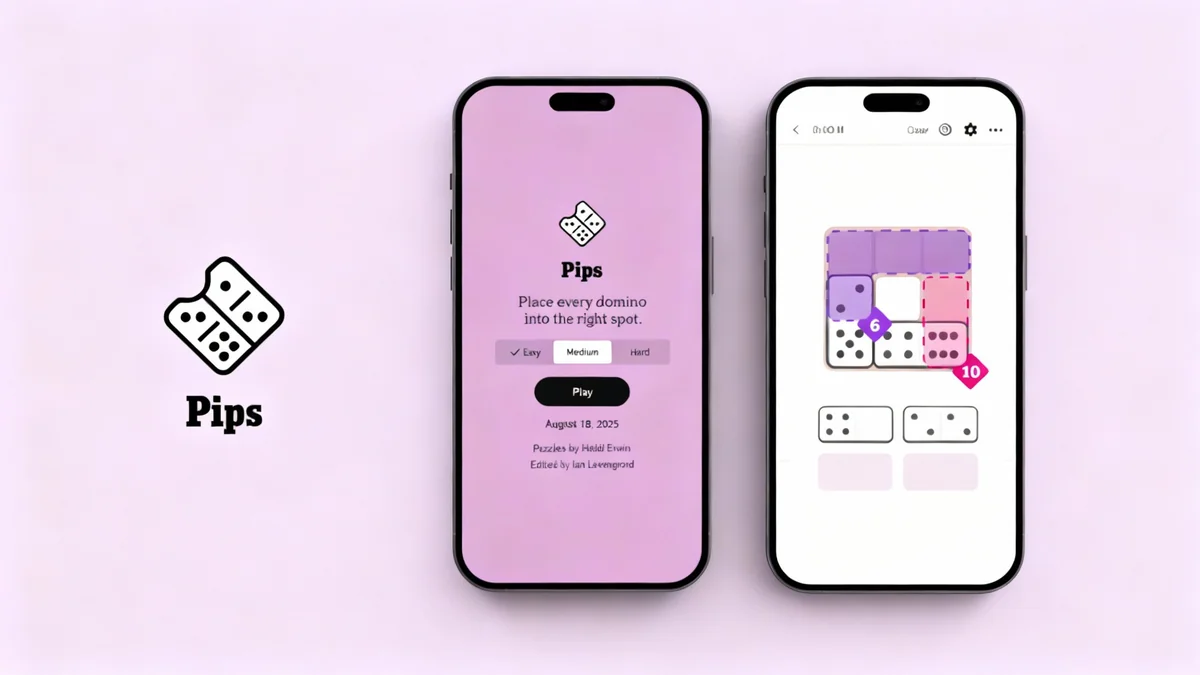

The New York Times has expanded its popular collection of daily puzzles with a new logic game called Pips. This fresh addition challenges players to fill a grid using a limited set of domino-like tiles, requiring a blend of spatial reasoning and mathematical deduction to satisfy various conditions within colored zones.
Unlike word-based games such as Wordle or Connections, Pips is a purely numerical and logical challenge. Players are presented with a grid divided into colored sections, each with a specific rule that must be met. The goal is to place every available domino onto the grid, ensuring all rules are simultaneously satisfied.
Key Takeaways
- Pips is a new domino-based logic puzzle offered by the New York Times Games platform.
- The objective is to fill a grid with all provided dominoes while adhering to rules in colored sections.
- Rules include conditions like equality (=), inequality (≠), greater than (>), less than (<), or matching an exact number.
- The game offers three difficulty tiers—Easy, Medium, and Hard—providing a scalable challenge for different skill levels.
How Pips Works: The Core Mechanics
At its heart, Pips is a game of constraints and placement. Each puzzle begins with an empty grid and a bank of dominoes. The grid is partitioned into several colored areas, and each area has a specific condition that the numbers (or 'pips') within it must meet.
Players must drag and drop the dominoes, which can be rotated, to cover the entire grid. The challenge lies in making sure that the final arrangement of pips fulfills every single condition on the board. Success requires using all dominoes and leaving no empty spaces.
The Rules of Engagement
The conditions are the core of the puzzle. Understanding them is the first step to mastering the game. The symbols are straightforward but create complex interactions.
- Equals (=): All pips within this colored zone must have the same value. For example, if one square in an '=' zone has a 3, all other squares in that same zone must also be 3s.
- Not Equals (≠): All pips within this zone must have different values from one another.
- Greater Than (>) or Less Than (<): The total sum of pips in this zone must be greater than or less than a specified number.
- Exact Number: A tile in this zone must match the exact number shown. A '4' condition means a 4-pip must be placed there.
- Blank Spaces: Some grid spaces have no color or condition. These are 'free' spaces where any pip value can be placed, often acting as crucial connectors between constrained zones.
Strategic Thinking in Pips
While the rules are simple, solving the puzzles, especially on harder difficulties, demands a strategic approach. Players cannot simply place dominoes at random. The process is one of deduction, elimination, and foresight.
Starting Points and Key Constraints
The most effective strategy often involves identifying the most constrained areas of the grid first. An area that requires an exact number, like a '4', immediately limits which dominoes can be placed there. For example, if your domino bank only has one tile with a '4' on it, you know exactly where that half of the domino must go.
Similarly, 'equals' (=) zones are powerful starting points. If a large '=' zone must be filled, you can scan your available dominoes to see which number appears frequently enough to fill all the required squares. This can quickly eliminate several dominoes and reveal placements for others.
The Power of the Domino Bank
A crucial part of the strategy is constantly referencing the available dominoes. Taking inventory of what you have—how many 1s, 2s, or blanks (0s) are available—helps you deduce what is possible. If a rule requires three '2's but you only have two '2' pips left in your bank, you know your current path is incorrect.
Solving a Hard Puzzle: A Walkthrough Example
To understand the game's depth, consider a typical two-column Hard puzzle. These layouts can be deceptive, as placements in one column heavily impact the other.
Imagine a board where the left column has a large purple '=' group and the right column also has a purple '=' group. The domino bank contains pairs of 1s, 0s, and 2s. A pink tile requires a '4'. This immediately tells us something important: the '=' groups cannot be 2s, because no 2-pip domino also has a 4-pip. The choice is between 1s and 0s.
Step-by-Step Deduction
- Identify the Keystone Piece: The pink '4' tile is the most restrictive clue. We find the dominoes that have a 4-pip, for instance, a 1/4 and a 0/4. This gives us two potential scenarios for the piece that fills the pink '4' tile.
- Test a Hypothesis: Let's assume the left column's purple '=' group is all 1s. We place the 1/1 domino there. This forces the 1/4 domino to connect from that purple zone into the pink '4' spot.
- Follow the Chain Reaction: With these dominoes placed, we see how they affect adjacent zones. If the 1/4 domino is used, the '4' is covered. Now, what about the other zones? A blue '=' zone might connect to the purple zone. If a 1/3 domino is placed from the purple '1's into the blue zone, then all blue squares must become '3's.
- Use Elimination: We continue placing dominoes based on this chain of logic. Eventually, we might find a contradiction—a point where no available domino can satisfy a remaining condition. If that happens, we know our initial assumption (that the left purple zone was '1's) was wrong. We would then backtrack and try the other possibility: making the left purple zone all '0's.
This process of hypothesis, placement, and verification is central to solving Pips. The satisfaction comes from seeing the logical chain fall into place, culminating in a perfectly completed grid.
The Appeal of Pips in a Crowded Market
Pips enters a competitive landscape of daily digital puzzles. Its strength lies in its unique gameplay that moves away from language and focuses on pure logic, offering a different kind of mental workout.
"The game's design encourages a methodical and calm approach. Unlike timed challenges, Pips allows players to think, experiment, and backtrack, making it a relaxing yet stimulating daily ritual."
The inclusion of Easy, Medium, and Hard tiers makes the game highly accessible. Newcomers can learn the ropes on simpler grids, while puzzle veterans can jump straight into the more complex challenges. This tiered system ensures a broad appeal and encourages daily engagement as players build their skills and confidence over time. It stands as a compelling alternative for those who prefer numbers and shapes over letters and words.