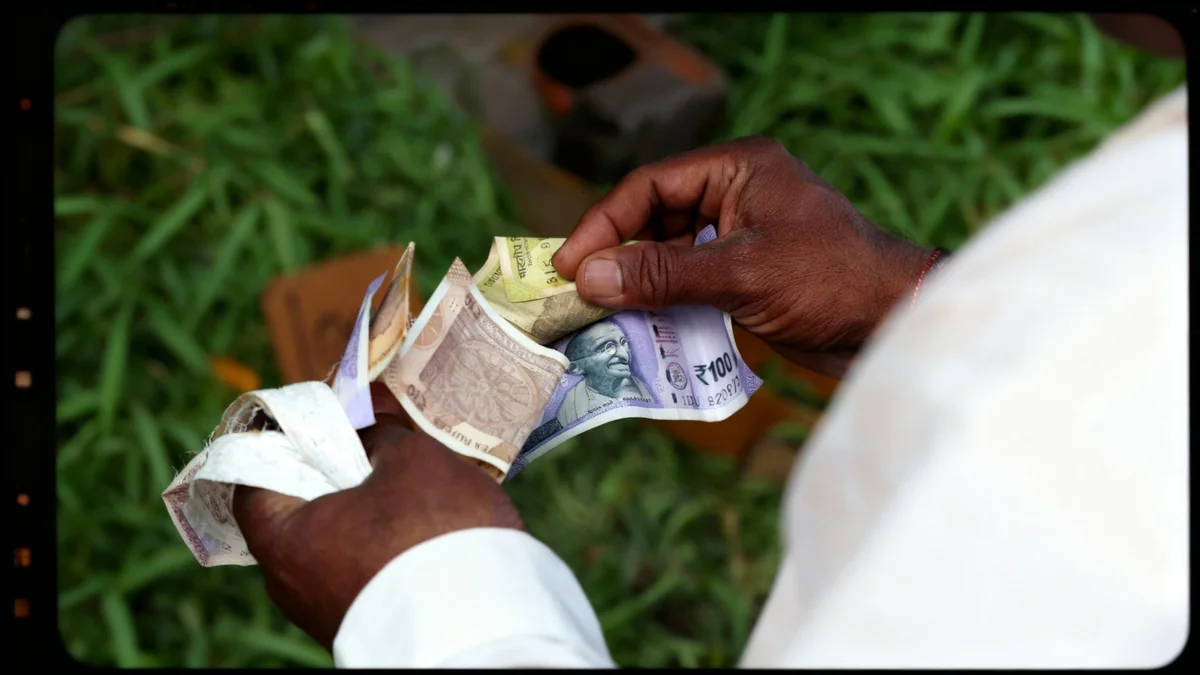

The Indian rupee fell to a new all-time low against the U.S. dollar on Friday, capping its second consecutive week of losses. The currency's decline is largely attributed to persistent investor concerns over the prolonged trade negotiations between India and the United States, which have created significant market uncertainty.
Despite the sharp dip in early trading, the rupee managed to pare some of its losses by the close of the session. The recovery was supported by intervention from India's central bank, which stepped in to stabilize the currency and prevent excessive volatility. However, market analysts anticipate the downward pressure will continue in the near term.
Key Takeaways
- The Indian rupee touched a record low of 90.55 per U.S. dollar on Friday before recovering slightly.
- The currency closed the week at 90.4150, marking a 0.5% decline for the week.
- Ongoing U.S.-India trade negotiations and steep American tariffs are the primary drivers of the rupee's weakness.
- India's central bank intervened in the market to support the currency and manage volatility.
- The rupee has underperformed other major Asian currencies, falling over 5% against the dollar this year.
Rupee Under Pressure as Trade Talks Stall
The rupee's recent performance reflects growing anxiety among investors about the status of trade relations between New Delhi and Washington. After reaching a low of 90.55 in early Friday trading, the currency stabilized following what traders identified as central bank action. It ultimately closed at 90.4150 per dollar.
This marks the second straight week of declines for the currency. The pressure has been building since the imposition of significant U.S. tariffs on key Indian exports. These trade barriers, some as high as 50%, have weighed heavily on India's economic outlook and, consequently, its currency.
Trade negotiations between the two nations collapsed in late July, primarily over disagreements related to U.S. access to India's agricultural markets. Although talks have since resumed, with a U.S. trade delegation visiting India this week, a clear resolution has yet to emerge.
High-Stakes Negotiations
The trade discussions are critical for both economies. India is seeking relief from tariffs that impact major exports, while the U.S. is pushing for greater market access for its farm products. The uncertainty surrounding these talks has become a major factor influencing foreign exchange markets.
Central Bank Intervention Limits Volatility
While the rupee has been on a downward trend, the market has not experienced extreme price swings. This is largely due to the proactive measures taken by India's central bank. By selling dollars from its foreign exchange reserves, the bank can support the rupee's value and ensure orderly market conditions.
Evidence of this managed decline can be seen in market volatility metrics. The one-month implied volatility for the rupee is currently at 4.2%, only slightly above its average for 2025. This indicates that while the direction is down, the central bank's presence is preventing panic and sharp, unpredictable movements.
Bankers and currency analysts suggest this strategy of managed depreciation is likely to continue. The central bank appears focused on smoothing the rupee's descent rather than aggressively defending a specific level, allowing the currency to adjust to economic fundamentals while curbing excessive speculation.
A Regional Outlier
The rupee's struggles stand in contrast to the performance of other major currencies in the region. On Friday, most Asian currencies posted gains against the U.S. dollar. The Chinese yuan, for instance, reached a 14-month high, highlighting a significant divergence in currency trends.
This has led to a notable weakening of the rupee against its regional peers. The Indian currency has depreciated by approximately 8% against the Chinese yuan this year, hitting a record low against the yuan on Friday as well. This underperformance makes Indian exports cheaper but increases the cost of imports from countries like China.
Asia's Worst Performer
With a year-to-date decline of over 5% against the U.S. dollar, the Indian rupee holds the distinction of being the worst-performing major currency in Asia for 2025.
Looking Ahead: Forecasts and Diplomatic Efforts
The outlook for the rupee remains cautious. Several financial institutions have revised their forecasts, anticipating further weakness. Analysts at Standard Chartered, for example, have projected that the currency could drift lower to 93 per dollar over the next 12 months, citing the ongoing trade pressures as the primary catalyst.
"Pressure on the currency has persisted since steep U.S. tariffs came into effect. We expect this to continue into 2026," noted analysts at Standard Chartered in a recent report.
Diplomatic efforts are underway to find a breakthrough. Indian Prime Minister Narendra Modi confirmed he spoke with U.S. President Donald Trump by phone on Thursday. These high-level discussions are aimed at de-escalating the trade dispute and finding a mutually agreeable path forward.
The market is now closely watching for any signs of progress. A successful resolution to the trade talks could provide significant relief for the rupee, while a continued stalemate would likely see the currency test new lows in the coming months.