
Silver and gold prices rebounded on Monday, recovering from a late dip after setting new all-time highs last week. The recovery was fueled by a dramatic surge in silver trading volumes on exchanges in New York and Shanghai, signaling heightened investor interest in precious metals.
Gold reached a new record of $4,346 per troy ounce in London last Friday, while silver peaked at $64.65. The subsequent trading activity suggests a robust underlying demand for hard assets amid a complex global economic picture.
Key Takeaways
- Gold and silver prices recovered on Monday after achieving record highs last week.
- Trading volume for silver futures on the US Comex exchange saw its highest turnover since October.
- The Shanghai Futures Exchange also reported its highest silver trading volume since May 2024.
- Investor inflows into precious metal ETFs, including both silver and gold funds, have increased significantly.
- Markets are now focused on upcoming interest rate decisions from the Bank of England, ECB, and Bank of Japan.
Unprecedented Trading Activity Fuels Price Recovery
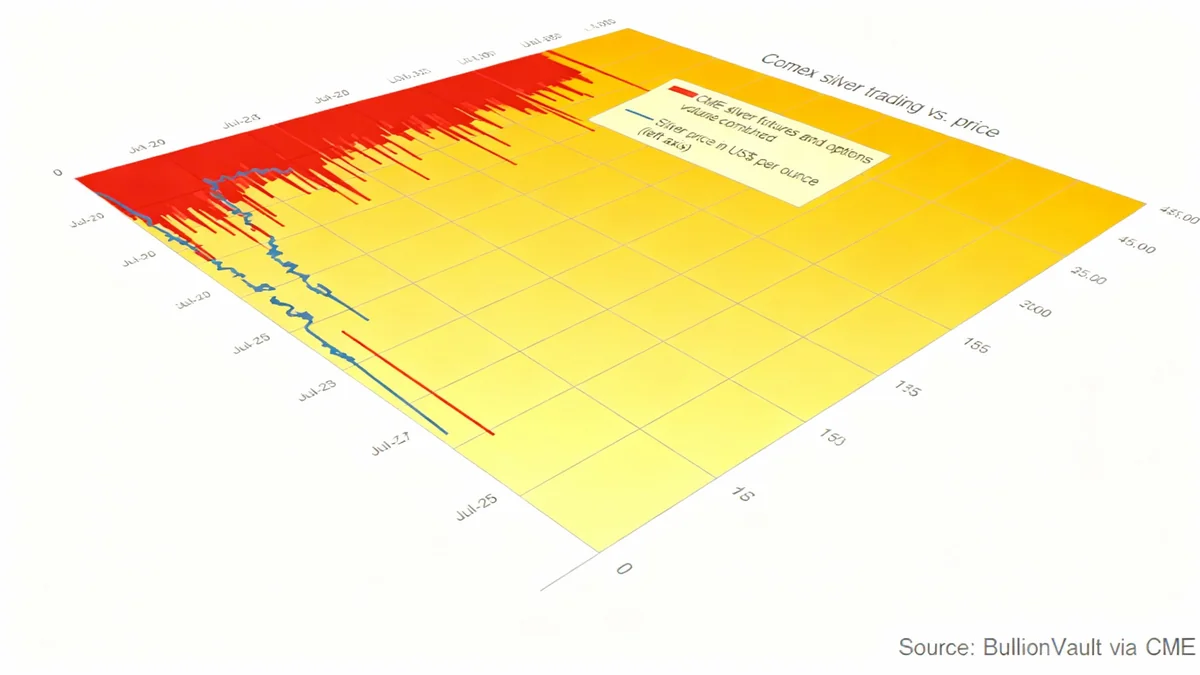
A significant spike in trading activity has been a primary driver of the latest price movements in the precious metals market. On Friday, trading volume for silver futures and options on the US Comex exchange reached a level surpassed only twice since 2020, marking the most active session since the physical supply squeeze noted in October.
This momentum carried over into the new week across the globe. On Monday, the Shanghai Futures Exchange (SHFE) saw silver contract turnover jump to its highest point since May 2024. This surge in Asia followed the intense activity in New York, underscoring a global rush into the metal.
Bruce Ikemizu, chief director of the Japan Bullion Market Association, noted the connection between the price and volume. "The biggest driver of Friday's rise in gold was arguably the sharp rally in silver," he said, highlighting the surge in Comex silver trading volumes as prices hit new peaks.
Industrial and Investment Demand Converge
Silver's dual role as both an industrial component and a financial asset is central to its current demand. Nearly 60% of silver's annual demand now comes from industrial applications, including solar panels and electronics. This foundational demand provides a strong price floor.
Context: Silver's Unique Position
Unlike gold, which is primarily a monetary and investment asset, silver's value is heavily influenced by industrial consumption. This makes its price sensitive to both economic growth (industrial demand) and financial uncertainty (safe-haven demand), creating a unique dynamic in the commodities market.
Analysts from Saxo Bank's Strategy Team stated in a recent note, "Silver is being underpinned by continued demand for hard assets and a tight, price-supportive supply outlook." This sentiment is reflected in the growing interest from institutional and retail investors seeking to hedge against inflation and economic uncertainty.
Investor Inflows Bolster Precious Metals ETFs
The renewed interest in precious metals is clearly visible in the flow of funds into exchange-traded funds (ETFs). The giant silver-backed ETF, SLV, expanded by 0.1% last week, reaching its largest size since July 2022. For the month, the fund has grown by 3.1%, its fastest rate of expansion since June.
Last week, silver experienced an 11.0% increase in London, its most significant weekly gain since the height of the COVID-19 crisis in August 2020.
Gold has not been left behind. Gold-backed trust funds also expanded last week, returning to levels last seen when the metal hit record prices in mid-October. The two largest funds, the SPDR Gold Trust (GLD) and the iShares Gold ETF (IAU), recorded net investor inflows of 0.3% and 1.1%, respectively.
This movement into ETFs indicates that investors are taking longer-term positions in precious metals, using these accessible financial products to gain exposure to the price of gold and silver without holding the physical bullion.
Global Markets Brace for Central Bank Decisions
The surge in precious metals comes during a pivotal week for global monetary policy. The market's focus is now squarely on the central bank meetings scheduled for Thursday and Friday. This follows last week's widely anticipated interest rate cut by the U.S. Federal Reserve.
Investors will be watching for decisions from:
- The Bank of England: A 0.25% rate cut is expected on Thursday.
- The European Central Bank (ECB): Expected to keep rates on hold for the 20-nation Eurozone.
- The Bank of Japan: Consensus points to a 0.25% rate increase on Friday.
These central bank decisions, particularly after the Fed's recent move, will heavily influence currency valuations and, by extension, the price of dollar-denominated commodities like gold and silver.
In addition to monetary policy, key economic data is on the horizon. U.S. employment figures for November are due on Tuesday, providing the first major insight into the labor market since the recent government shutdown. This will be followed by the U.S. consumer price index (CPI) on Thursday, a critical inflation indicator.
While Asian stock markets declined on Monday, tracking Wall Street's losses led by AI-related equities, European markets showed resilience. The pan-European Stoxx 600 index rose 0.8%, and U.S. stock futures also pointed to a positive open, creating a mixed backdrop for commodity markets as the final full trading week before Christmas gets underway.