
Gold prices experienced a modest decline on Tuesday as investors moved to secure profits following a record-setting session. The precious metal had surged to an all-time high on Monday, fueled by expectations of impending interest rate cuts by the U.S. Federal Reserve and strong demand for safe-haven assets.
The pullback reflects a natural market correction after a significant rally, though underlying support for gold remains firm. Market participants are now turning their attention to upcoming U.S. inflation data, which could influence the Federal Reserve's next policy move.
Key Takeaways
- Spot gold prices fell 0.3% after reaching an all-time high of $4,381.21 in the previous session.
- The primary reason for the dip is attributed to investors taking profits after the recent surge.
- Market sentiment is strongly positioned for two more interest rate cuts from the U.S. Federal Reserve this year.
- Upcoming Consumer Price Index (CPI) data is a critical factor that could impact gold's short-term trajectory.
Profit-Taking Follows Record-Breaking Rally
On Tuesday, spot gold was trading down 0.3% at $4,340.29 per ounce. This follows a historic session on Monday when the metal climbed to a new peak of $4,381.21. Similarly, U.S. gold futures for December delivery saw a slight decrease of 0.1%, settling at $4,356.40 per ounce.
Analysts suggest this movement is a typical response to a rapid price increase. When an asset reaches a new high, some investors choose to sell their holdings to realize the gains, a process known as profit-taking. This selling pressure can cause a temporary dip in the price.
"Profit-taking moves and an abating of safe-haven flows combined to just take the edge off the gold price today," said Tim Waterer, Chief Market Analyst at KCM Trade. He added that the underlying trend remains positive.
Waterer noted that many investors are likely to view this price dip as a chance to buy. "Any pullbacks on gold will be viewed as buying opportunities whilst the Fed remains on their current rate-cutting trajectory," he explained.
Federal Reserve Policy Remains Key Driver
The primary force behind gold's recent strength is the widespread expectation that the U.S. Federal Reserve will continue to lower interest rates. Lower rates reduce the opportunity cost of holding non-yielding assets like gold, making it more attractive to investors compared to interest-bearing instruments like bonds.
Market Expectations
According to the CME FedWatch Tool, financial markets are fully pricing in a quarter-point interest rate cut from the Federal Reserve this month. Furthermore, another cut is anticipated in December.
This outlook for looser monetary policy has been a significant tailwind for the precious metal throughout the year. As central banks ease policy to support economic growth, assets that hold their value during times of uncertainty, such as gold, often see increased demand.
Economic Data and Geopolitical Factors in Focus
Inflation Data on the Horizon
Investors are now closely watching for the release of the U.S. Consumer Price Index (CPI) on Friday. This key inflation report was delayed due to the ongoing government shutdown. The data will provide a crucial update on price pressures within the economy and could sway the Fed's decision-making process.
Economists surveyed by Reuters anticipate the report will show a 3.1% year-over-year increase in consumer prices for September. According to Tim Waterer, "The current gold rally has further room to run on the topside provided that U.S. CPI data later this week doesn’t produce any nasty upside surprises." A higher-than-expected inflation figure could complicate the Fed's path to cutting rates.
Government Shutdown and Trade Tensions
The U.S. government shutdown, now in its 20th day, has caused delays in the release of important economic statistics, creating a data vacuum for policymakers and investors. However, White House economic adviser Kevin Hassett stated on Monday that he expects the shutdown is likely to end this week.
Separately, on the international trade front, U.S. Treasury Secretary Scott Bessent is scheduled to meet with Chinese Vice Premier He Lifeng in Malaysia. The talks are aimed at preventing an escalation of U.S. tariffs on Chinese goods, another source of global economic uncertainty that has supported safe-haven demand for gold.
Performance of Other Precious Metals
While gold captured most of the attention, other precious metals showed mixed results. The market for these metals often moves in relation to gold but is also influenced by specific industrial demand drivers.
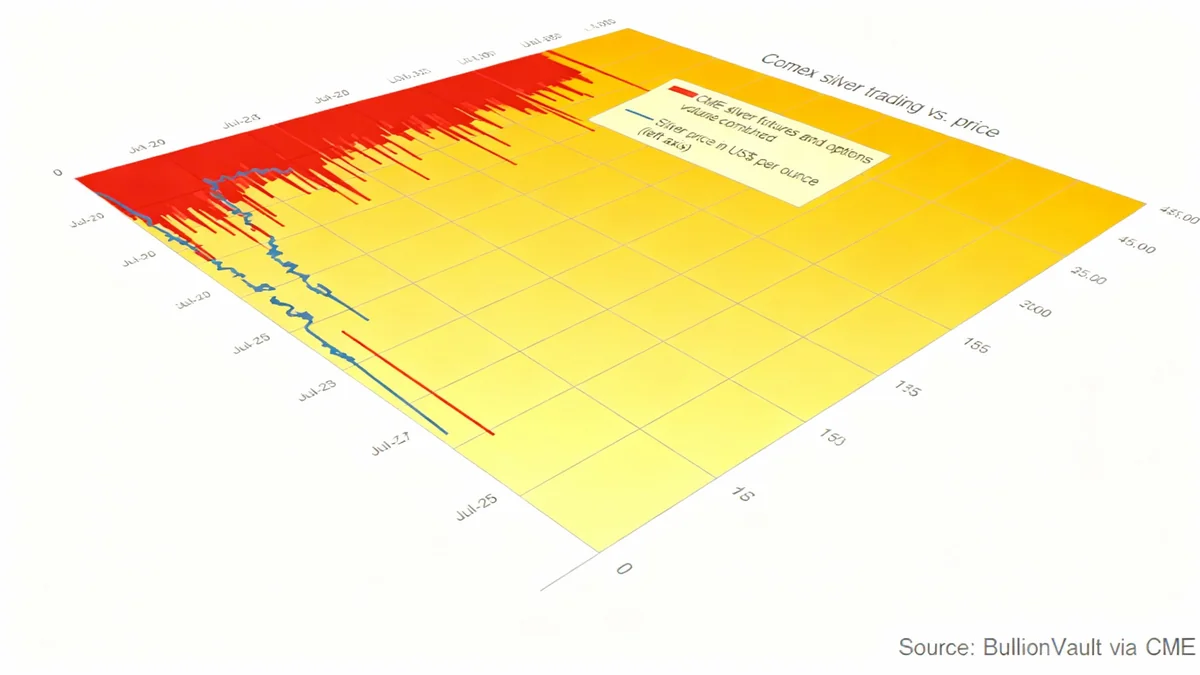
- Silver: Spot silver experienced a more significant dip than gold, falling 1.6% to $51.64 per ounce.
- Platinum: The industrial metal slipped 0.7%, trading at $1,627.62 per ounce.
- Palladium: Bucking the trend, palladium gained 0.5% to reach $1,503.17 per ounce.
The varied performance highlights the complex factors influencing the broader commodities market, where investor sentiment, monetary policy, and industrial applications all play a crucial role.