
Silver prices surged to a new all-time high this week, touching over $64 per ounce as the global market grapples with a structural supply deficit now entering its fifth consecutive year. The rally is fueled by a combination of robust industrial demand, particularly from green technology sectors, and heightened interest from investors seeking a hedge against economic uncertainty.
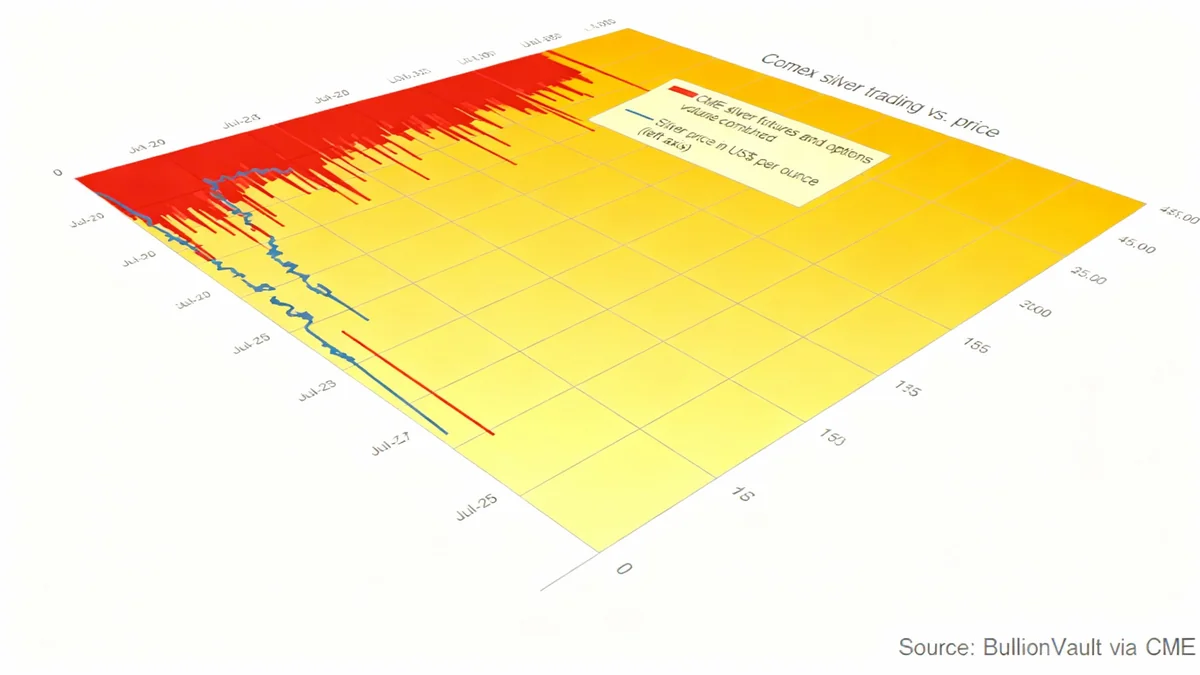
On December 11, spot silver reached an intraday peak of $64.2062, just two days after breaking the significant $60 threshold. This price movement represents a near doubling of silver's value since the beginning of 2025, significantly outperforming gold and other precious metals during the same period.
Key Takeaways
- Record Price: Silver reached a new historical high of $64.2062 per ounce on December 11, 2025.
- Supply Deficit: The global silver market is in its fifth straight year of a supply shortfall, with demand consistently exceeding production.
- Demand Drivers: Strong demand comes from both industrial applications like solar panels and electronics, as well as investors seeking a safe-haven asset.
- Bullish Forecasts: Some major financial institutions project silver could reach as high as $100 per ounce by the end of 2026.
A Market Tightens: Silver's Historic Price Surge
The precious metal's recent performance has captured the attention of global markets. The ascent began to accelerate in late November, with prices consistently trading in the upper $50s. The breakout past $60 per ounce on December 9 was a major psychological milestone, paving the way for the subsequent climb to over $64.
This rally is not a sudden event but the culmination of years of market imbalance. According to the 2025 World Silver Survey from the Silver Institute, the market is facing one of its most significant shortfalls in recent history, a situation that has steadily pushed prices upward.
By the Numbers: Silver's 2025 Rally
- New All-Time High: $64.2062 per ounce
- Year-to-Date Gain: Nearly doubled in value since the start of 2025
- Projected 2025 Deficit: Approximately 117 million ounces (3,660 tonnes)
The Root Cause: A Persistent Supply and Demand Imbalance
The core issue driving silver's price is a fundamental mismatch between how much is produced and how much is needed. For five years, the world has used more silver than it has mined and recycled, steadily depleting available stockpiles.
Stagnant Mine Production
Global mine production has remained largely flat. The Silver Institute reports that total mined supply for 2025 is expected to be around 813 million ounces, a figure that has not changed significantly in recent years. Unlike other commodities, higher prices do not quickly translate into more silver production. This is because a large portion of silver is extracted as a by-product from mining operations for other metals like copper, lead, and zinc.
Surging Industrial and Investment Demand
While supply has been static, demand has soared. Industrial fabrication has hit record levels, driven by two key areas:
- Green Technology: Silver is an essential component in photovoltaic cells for solar panels. The global push toward renewable energy has created a massive and growing source of demand.
- Electronics: The metal's superior conductivity makes it indispensable in everything from smartphones to electric vehicles.
Simultaneously, investors have been flocking to silver. Amid concerns about inflation, currency fluctuations, and general economic instability, many see silver as both a reliable store of value and an industrial commodity with real-world utility, giving it an advantage over other safe-haven assets.
What's Next? Analysts Eye Higher Prices
Market analysts and financial institutions are increasingly bullish on silver's future prospects. The consensus is that the structural deficit is likely to persist through 2026, providing continued support for higher prices.
Analyst Projections
Several major banks have revised their forecasts for silver. Bank of America recently raised its 12-month price target to $65 per ounce. More aggressively, analysts at BNP Paribas have suggested that silver could potentially climb as high as $100 per ounce by the end of 2026, citing persistent inflation and geopolitical risks that drive investors toward hard assets.
However, the path forward is not without potential obstacles. Extremely high prices could incentivize industries to find cheaper substitutes for silver or to develop new technologies that use less of the metal. Furthermore, a significant shift in macroeconomic conditions, such as rising interest rates or subsiding inflation, could dampen investor appetite for non-yielding assets like silver.
Meeting the Supply Challenge
With the market so tight, attention is turning to mining companies that can bring new, reliable sources of silver online. The industry needs producers who can efficiently extract high-grade silver to help close the widening supply gap.
One company positioned to contribute is Sierra Madre Gold and Silver, which is developing key projects in Mexico, one of the world's top silver-producing countries. The company's La Guitarra mine began commercial production in January 2025 and is already working on expansion plans. Along with its Tepic project, which holds high-grade potential, such operations are becoming critical to supporting the global demand from both green energy initiatives and investors.
As the world continues its transition to cleaner energy and navigates an uncertain economic landscape, silver's dual role as a crucial industrial material and a strategic financial asset has never been clearer. The current price rally may be more than a temporary spike; it could be a revaluation of a metal essential for the future.