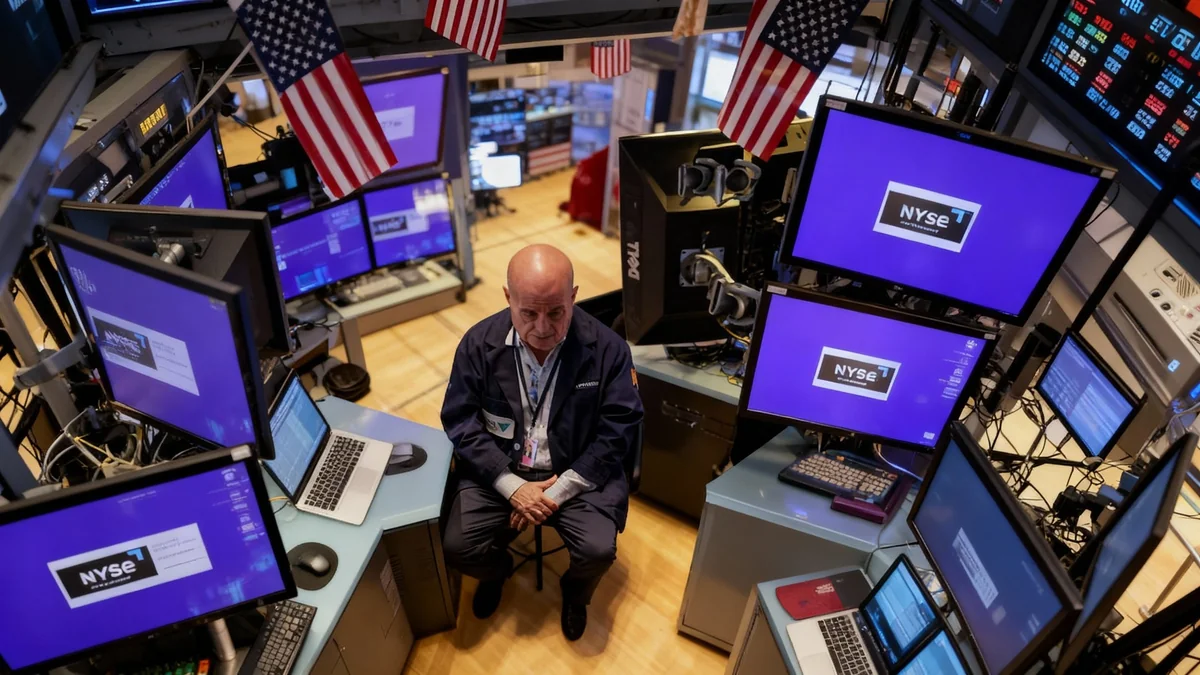

U.S. stock markets experienced a significant downturn on Monday as investors grew cautious ahead of a crucial earnings report from chipmaker Nvidia and a wave of delayed economic data. The sell-off affected all three major indexes, reflecting broader concerns about technology stock valuations and uncertainty surrounding the nation's economic health.
The Dow Jones Industrial Average, S&P 500, and Nasdaq Composite all registered notable losses, ending a period of relative calm in the market. The downward pressure was accompanied by a slight dip in U.S. Treasury yields, while the dollar strengthened against other major currencies.
Key Takeaways
- Major U.S. stock indexes, including the Dow Jones and S&P 500, fell sharply amid investor caution.
- Anticipation of Nvidia's quarterly earnings report is fueling concerns about high valuations in the artificial intelligence sector.
- A backlog of economic data, including key employment figures, is set to be released, creating market uncertainty.
- Treasury yields edged lower, while the U.S. dollar gained strength. Bitcoin erased its gains for the year.
Market Sell-Off Driven by Tech and AI Concerns
The technology sector, which has been a primary driver of market gains in recent months, led the day's decline. The Nasdaq Composite fell by 192.51 points, or 0.84%, to close at 22,708.08. The broader S&P 500 dropped 61.72 points (0.92%) to 6,672.39, while the Dow Jones Industrial Average saw the steepest decline, falling 557.24 points (1.18%) to finish at 46,590.24.
Market analysts point to growing anxiety surrounding the artificial intelligence (AI) sector. All eyes are on Nvidia, the AI chip giant scheduled to release its quarterly results this Wednesday. The report is widely seen as a barometer for the entire AI industry, and investors are scrutinizing it for any signs of slowing demand.
"I think we're seeing some follow-through on last week's pullback, particularly in the tech sector focusing on the AI trade," said Matthew Keator, managing partner at the Keator Group. "The question is do the valuations justify the stock price?"
Keator also noted underlying concerns about how the rapid adoption of AI might affect future employment figures, adding another layer of complexity for investors.
Economic Data Deluge Creates Uncertainty
Adding to the market's unease is an unusual influx of economic reports scheduled for this week. A recent U.S. government shutdown caused a delay in the release of official data, and federal agencies are now playing catch-up.
Backlog of Reports
The end of the longest U.S. government shutdown in history means that several weeks' worth of key economic indicators will be released in a compressed timeframe. This includes crucial data on employment, inflation, and consumer spending, leaving investors with a great deal of new information to process at once.
The most anticipated release is the Labor Department's September employment data, slated for Friday. This report is a critical indicator of the economy's strength and could influence the Federal Reserve's next move on interest rates.
"There's a great deal of uncertainty about what to expect from several months of data, and over the period of the next several weeks that's going to be a big focus," commented Tim Ghriskey, a senior portfolio strategist at Ingalls & Snyder.
Spotlight on Corporate Earnings
While the third-quarter earnings season is nearly complete, a few high-profile reports remain. So far, the season has been strong, with 83% of the S&P 500 companies that have reported exceeding profit expectations, according to LSEG data.
However, Nvidia's upcoming report carries exceptional weight due to its central role in the AI boom. Its performance could either validate the sky-high valuations of AI-related stocks or trigger a broader correction in the tech sector.
Beyond technology, investors will also be watching earnings from major retailers, including:
- Home Depot
- Target
- Walmart
These companies will provide vital insights into the state of consumer demand, a key pillar of the U.S. economy, heading into the holiday shopping season.
Broader Market Reactions
The cautious mood on Wall Street rippled across other financial markets. In the bond market, U.S. Treasury yields dipped as some investors sought safer assets. The benchmark 10-year Treasury note yield fell 1.3 basis points to 4.135%.
Global Market Snapshot
- European Stocks: The pan-European STOXX 600 index fell 0.54%.
- U.S. Dollar: The dollar index, which measures the greenback against a basket of currencies, rose 0.23% to 99.55.
- Crude Oil: U.S. crude settled at $59.91 per barrel, while Brent crude was at $64.20.
- Gold: Spot gold fell 0.9% to $4,042.39 an ounce.
The cryptocurrency market also faced downward pressure. Bitcoin fell 1.53% to $92,008.68, a move that erased all of its year-to-date gains and marked its lowest point since late April. Ethereum also declined, falling 1.66% to $3,021.44. Investors now await the coming data releases and corporate reports to find a clearer direction for the market.