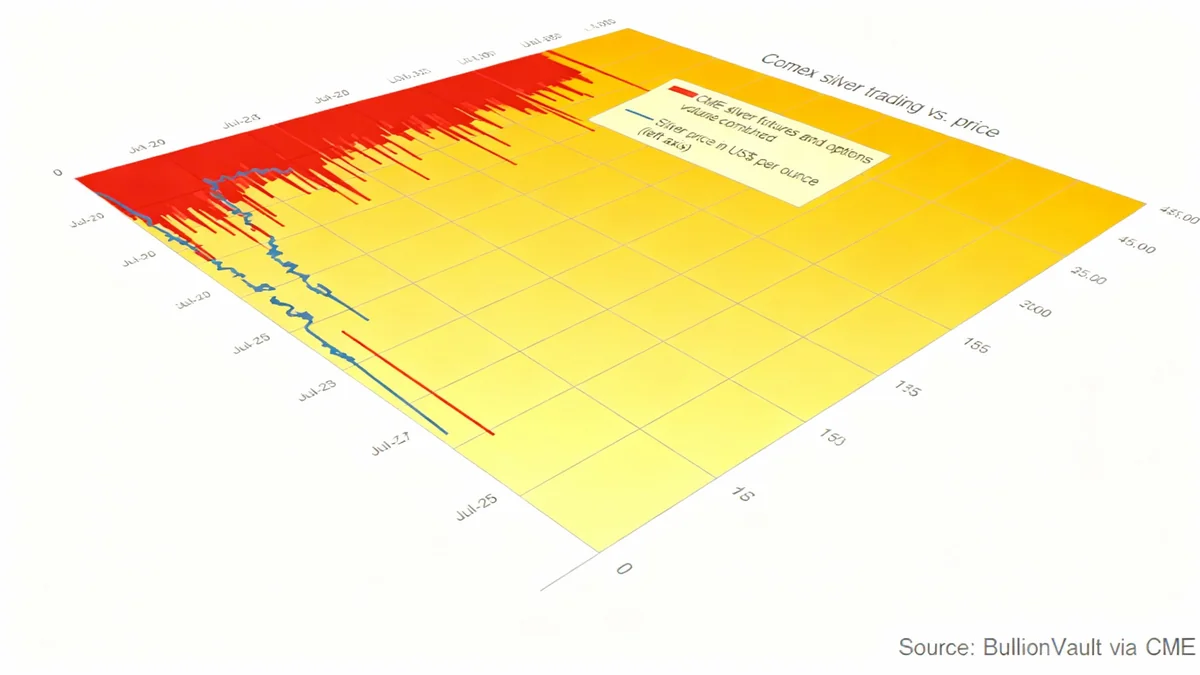
Gold prices have exceeded $4,000 per ounce for the first time in history, driven by a wave of investor uncertainty. Market participants are increasingly moving capital into the precious metal as a safeguard against persistent inflation, geopolitical instability, and concerns about the long-term value of fiat currencies.
This surge in gold coincides with growing caution in equity markets, particularly in the technology sector, where questions about the profitability of artificial intelligence investments have emerged. The S&P 500 recently ended a seven-day winning streak, reflecting a broader shift in market sentiment.
Key Takeaways
- Gold's price reached a new all-time high, crossing the $4,000 per ounce mark for the first time.
- Investor demand is fueled by economic uncertainty, a weaker U.S. dollar, and persistent inflation.
- Bridgewater Associates founder Ray Dalio recommends a 15% portfolio allocation to gold, comparing current conditions to the 1970s.
- Technology stocks faced a pullback, with Oracle's shares declining over concerns about low margins in its AI-related cloud business.
- The S&P 500 snapped a multi-day winning streak as investors re-evaluated the immediate profitability of the AI sector.
Investors Flock to Gold Amid Economic Headwinds
The price of gold has reached a significant milestone, breaking the $4,000 per ounce barrier. This record-setting rally is not an isolated event but rather the culmination of sustained investor demand for safe-haven assets. A combination of global factors is contributing to this trend.
According to market analysts, a primary driver is the search for a reliable store of value. With inflation remaining more stubborn than anticipated in several major economies, investors are concerned about the erosion of purchasing power associated with traditional paper currencies. Geopolitical volatility in various regions has also added to the uncertainty, prompting a flight to assets perceived as stable.
Why Gold?
Historically, gold is viewed as a hedge against economic turmoil. Unlike stocks or bonds, it does not depend on the performance of a specific company or government. Its value is often inversely correlated with the U.S. dollar, meaning it tends to rise when the dollar weakens.
The famous investor J.P. Morgan testified before the U.S. Congress in 1912, stating, "Gold is money, everything else is credit." This century-old sentiment appears to be resonating with modern investors who are increasingly wary of credit-based financial systems and are seeking the tangible security that gold offers.
Ray Dalio Advocates for Increased Gold Allocation
Prominent investor Ray Dalio, the founder of the massive hedge fund Bridgewater Associates, has issued a strong recommendation for holding gold. He suggests that investors should consider allocating as much as 15% of their portfolios to the precious metal, a figure that is substantially higher than what most financial advisors typically recommend.
Dalio draws a parallel between the current economic environment and the early 1970s. That period was characterized by high government debt, monetary uncertainty, and a general decline in confidence in fiat currencies and other paper assets. He argues that similar conditions exist today, making gold a crucial component for portfolio diversification.
"Dalio's recommendation contrasts with typical portfolio guidance of financial advisors which tells clients to hold mostly stocks and some bonds in a 60-40 split," a market report noted. Alternative assets like gold are usually suggested in low single-digit percentages due to their lack of income generation.
This perspective challenges conventional wisdom, which often prioritizes income-generating assets like stocks and bonds. Dalio's view is that in the current climate, capital preservation is as important as growth, and gold serves this purpose effectively.
The Buffett Counterpoint
Not all legendary investors share this enthusiasm for gold. Warren Buffett has famously been a skeptic. In 1998, he remarked on gold's lack of practical use: "[Gold] gets dug out of the ground in Africa, or someplace. Then we melt it down, dig another hole, bury it again and pay people to stand around guarding it. It has no utility. Anyone watching from Mars would be scratching their head." While this view highlights gold's non-productive nature, current market behavior indicates that earthly investors are prioritizing its role as a safe haven.
Tech Sector Faces Profitability Concerns
While gold shines, a shadow has fallen over parts of the technology sector. The recent rally in stocks, largely driven by enthusiasm for artificial intelligence, has hit a pause. The S&P 500 recently ended a seven-day winning streak, falling 0.38%. The Nasdaq and Dow Jones Industrial Average also posted losses, as did the European Stoxx 600 index.
The primary reason for the pullback is growing investor concern about the actual profitability of massive AI investments. A key example is Oracle, whose shares fell after a report questioned the financial viability of its plan to spend billions on Nvidia chips for its cloud rental business.
The report highlighted that Oracle's Nvidia cloud business had gross margins of just 14% in the quarter ending in August. This is a stark contrast to the company's overall margin of approximately 70%, raising questions about the return on its significant capital expenditure in the AI space.
Nvidia and OpenAI Deepen Partnership
Despite broader market jitters, leaders in the AI space continue to forge ahead. Nvidia and OpenAI have announced their first "direct partnership," a move that signals a deepening collaboration between the premier AI chipmaker and the leading AI research lab.
Nvidia CEO Jensen Huang confirmed the deal, which follows an announcement that the chip giant plans to invest up to $100 billion in OpenAI to expand its AI data center capacity. This partnership underscores the immense capital required to build and operate cutting-edge AI models.
However, even with such landmark deals, some market watchers remain cautious. Josh Brown, CEO of Ritholtz Wealth Management, acknowledged that an "artificial intelligence-driven bubble has emerged in the market." He did, however, add that there are still many "real projects" where investors can confidently allocate funds, suggesting a need for careful discernment in the sector.