
In a clear display of diverging investor strategies, two of the market's most popular exchange-traded funds (ETFs) are experiencing opposite capital movements. The Vanguard S&P 500 ETF (VOO) has attracted approximately $1 billion in net inflows over the past five days, while the Schwab U.S. Dividend Equity ETF (SCHD) has seen net outflows of around $122 million during the same period.
This contrast highlights a broader market theme where some investors are continuing to buy into the overall U.S. stock market's growth potential, while others are pulling back from dividend-focused strategies amid shifting economic conditions.
Key Takeaways
- The Vanguard S&P 500 ETF (VOO) recorded net inflows of roughly $1 billion in the last five trading days.
- The Schwab U.S. Dividend Equity ETF (SCHD) experienced net outflows of approximately $122 million over the same period.
- VOO has demonstrated strong year-to-date performance with a 15.57% gain, whereas SCHD is up a modest 0.60%.
- Despite differing fund flows, both ETFs hold a "Moderate Buy" consensus rating from market analysts.
A Clear Divide in Investor Capital
The flow of money into and out of ETFs provides a real-time gauge of market sentiment. The recent data shows a significant preference for broad market exposure over high-dividend stocks. The nearly $1 billion entering VOO suggests sustained confidence in the large-cap U.S. companies that make up the S&P 500 index.
Conversely, the $122 million withdrawn from SCHD indicates a more cautious stance from investors who typically favor dividend-paying stocks for income and stability. This move could reflect concerns about the performance of value-oriented companies in the current market cycle or a simple rotation into assets perceived to have higher growth potential.
Performance and Market Outlook
The performance gap between the two funds this year is stark. VOO, which mirrors the S&P 500, has delivered a robust 15.57% return year-to-date. This growth has been largely driven by a handful of technology and large-cap stocks that dominate the index.
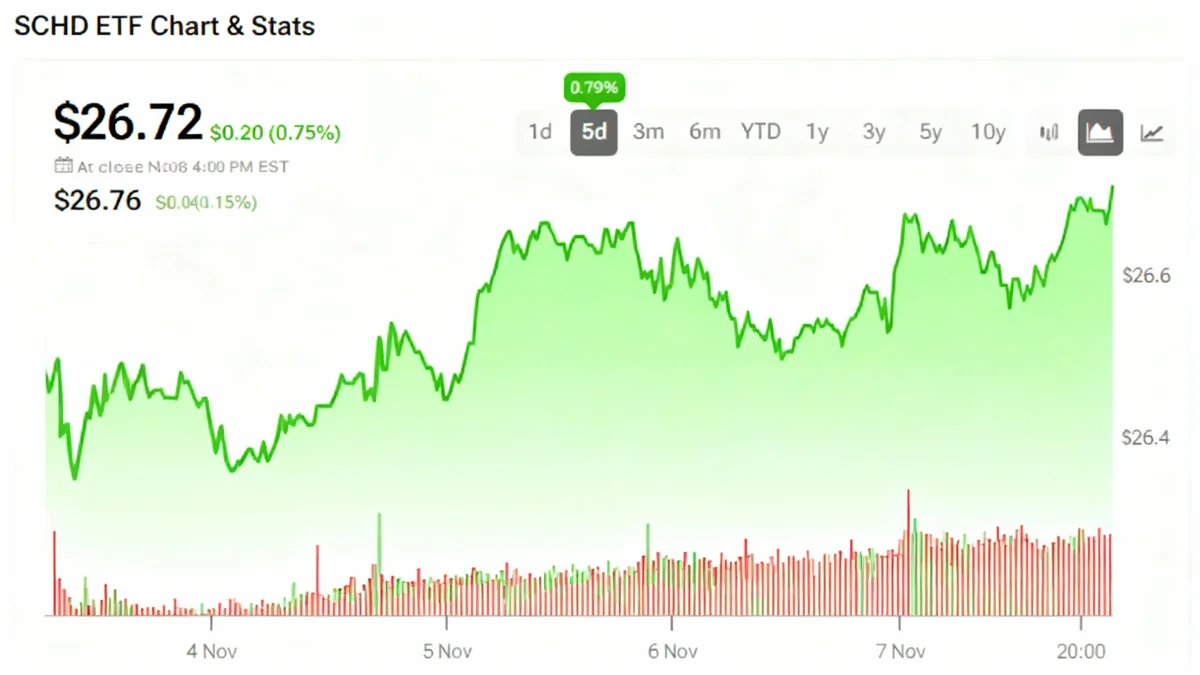
In contrast, SCHD, which tracks the Dow Jones U.S. Dividend 100 Index, has posted a much smaller gain of 0.60% year-to-date. While it has seen a slight uptick of 0.79% in the past five days, its overall performance lags significantly behind the broader market.
Understanding the Strategies
VOO offers investors a simple way to own a piece of the 500 largest publicly traded companies in the United States, providing diversified exposure to the overall economy. SCHD focuses on 100 U.S. stocks selected for their history of consistent dividend payments, appealing to those seeking regular income and potential long-term value.
Analyst Consensus and Price Targets
Despite the divergence in fund flows and performance, analysts maintain a cautiously optimistic outlook for both ETFs. Both VOO and SCHD currently hold a "Moderate Buy" consensus rating, derived from a weighted average of analyst ratings on their underlying holdings.
However, the projected upside differs. The average analyst price target for VOO stands at $719.72, suggesting a potential upside of 16.67% from its current level. For SCHD, the average price target is $30.46, implying a slightly lower potential upside of 13.99%.
Smart Score Ratings
A proprietary scoring system gives VOO a "Smart Score" of 8 out of 10, which implies the ETF is likely to outperform the market. SCHD holds a score of 7, suggesting it is expected to perform in line with the market.
A Look Inside the Holdings
The future performance of these ETFs is tied directly to the companies they hold. Examining their top components reveals where analysts see the most potential for growth and risk.
VOO's Potential Winners and Losers
For the Vanguard S&P 500 ETF, analysts see the highest upside potential in a diverse group of companies, including:
- Loews (L)
- Fiserv, Inc. (FI)
- DuPont de Nemours (DD)
- Dexcom (DXCM)
- Moderna (MRNA)
On the other hand, some of its holdings are projected to face challenges. The stocks with the greatest potential downside include Ford Motor (F), Paramount Skydance (PSKY), Incyte (INCY), Expeditors International (EXPD), and Tesla (TSLA).
SCHD's Key Holdings
For the Schwab U.S. Dividend Equity ETF, the outlook is different. The holdings with the highest anticipated upside are concentrated in the industrial, materials, and energy sectors:
- Insperity Inc. (NSP)
- FMC Corp. (FMC)
- EOG Resources (EOG)
- Schlumberger (SLB)
- Inter Parfums (IPAR)
Conversely, holdings with the largest potential downside include American Financial Group (AFG), The Buckle Inc. (BKE), Carter’s (CRI), Western Union (WU), and Ford Motor (F), which appears on the downside list for both ETFs.
Dividends as a Factor
A key difference between the two funds is their approach to income. VOO does pay a dividend, sourced from the payouts of the S&P 500 companies it holds. These are distributed quarterly, and the current yield is 1.14%. While a source of income, it is not the fund's primary objective.
SCHD, by its very nature, is designed to provide a stronger stream of dividend income. Its strategy of focusing on high-quality, dividend-paying stocks is intended to attract investors prioritizing regular cash flow over pure capital appreciation. The recent outflows suggest that in the current environment, more investors are choosing the growth-oriented path offered by broad market funds like VOO.